
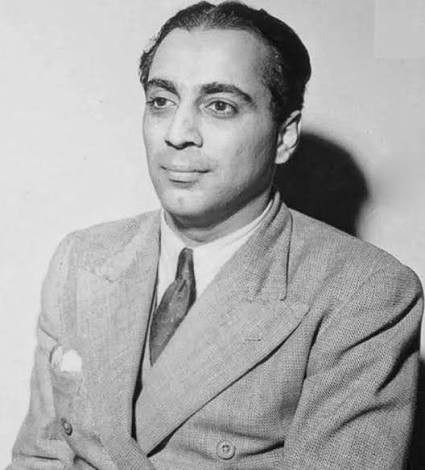
Homi J. Bhabha
Nuclear Physicist and Father of the Indian Nuclear Programme
🌍 Indian · Born October 30, 1909 · Died January 24, 1966
About
Homi Jehangir Bhabha was an eminent Indian nuclear theoretical physicist widely recognized as the father of the Indian nuclear program. Educated at the University of Cambridge, Bhabha made foundational contributions to theoretical physics, including the mathematical explanation of relativistic electron-positron scattering, a phenomenon now known as Bhabha scattering, as well as work on cosmic rays and the cascade process of electron showers. Following the outbreak of World War II, Bhabha returned to India and joined the Indian Institute of Science in Bangalore as a reader under Nobel laureate C. V. Raman. Recognizing the critical importance of nuclear research for national development, Bhabha persuaded the Sir Dorabji Tata Trust to establish the Tata Institute of Fundamental Research in Mumbai in 1945, serving as its founding director. In 1948, he became the first Chairman of the Atomic Energy Commission of India, establishing the country's three-stage nuclear power program designed to utilize indigenous thorium reserves. Bhabha also founded the Atomic Energy Establishment, Trombay in 1954, which was later renamed the Bhabha Atomic Research Centre in his honor. A Fellow of the Royal Society and recipient of the Padma Bhushan, Bhabha represented India on international scientific platforms, serving as President of the United Nations Conference on the Peaceful Uses of Atomic Energy in 1955. He died in a plane crash near Mont Blanc in 1966.
Intelligence Summary
Top Connections
Elected Fellow of the Royal Society
Elected as a Fellow of the Royal Society of London for his contributions to theoretical physics and cosmic radiation research.
Awarded Adams Prize
Received the Adams Prize from the University of Cambridge for his work on theoretical physics and elementary particles.
Founded TIFR
Established the Tata Institute of Fundamental Research in Mumbai with support from J. R. D. Tata and the Sir Dorabji Tata Trust.
Appointed AEC Chairman
Became the founding Chairman of the Atomic Energy Commission of India upon its creation by the Government of India.
Founded AEET and Awarded Padma Bhushan
Established the Atomic Energy Establishment, Trombay and was awarded India's Padma Bhushan civilian honor.
Chaired UN Geneva Conference
Served as President of the inaugural United Nations Conference on the Peaceful Uses of Atomic Energy in Geneva.
Passed Away in Air Crash
Died in the crash of Air India Flight 101 on the Mont Blanc massif in France.
No organizations found.
All data sourced from verified public references.