
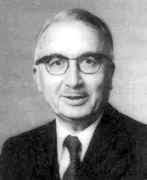
Henri Cartan
Influential French mathematician and co-founder of Bourbaki
🌍 French · Born July 8, 1904 · Died August 13, 2008
About
Henri Cartan was one of the most influential French mathematicians of the twentieth century, renowned for his foundational contributions to algebraic topology, complex analysis, homological algebra, and sheaf theory. Born in Nancy, France, as the son of the eminent mathematician Elie Cartan, he studied at the Ecole Normale Superieure in Paris, where he later became a highly influential professor. Through his famous Seminar Cartan, which ran from 1948 to 1964, he shaped generations of French and international mathematicians. Cartan is widely recognized as a founding member of the Nicolas Bourbaki group, a collective of French mathematicians who sought to reformulate mathematics on a highly rigorous and axiomatic basis. His collaboration with Samuel Eilenberg led to the publication of Homological Algebra in 1956, a seminal text that defined the entire field. Throughout his life, Cartan was also a dedicated defender of human rights, actively advocating for dissident scientists behind the Iron Curtain. He served as the president of the International Mathematical Union from 1967 to 1970 and received numerous accolades, including the CNRS Gold Medal in 1976 and the Wolf Prize in Mathematics in 1980.
Intelligence Summary
PhD Graduation
Completed his doctorate at the Ecole Normale Superieure under the direction of Paul Montel.
Founding of Bourbaki
Co-founded the Nicolas Bourbaki group of mathematicians to write a comprehensive treatise on modern mathematics.
Seminar Cartan Launched
Established the highly influential Seminar Cartan at the Ecole Normale Superieure, running for over fifteen years.
IMU Presidency
Elected President of the International Mathematical Union, serving until 1970.
CNRS Gold Medal
Received the Gold Medal of the French National Centre for Scientific Research, the country's highest scientific honor.
Wolf Prize in Mathematics
Awarded the Wolf Prize in Mathematics for his pioneering work in algebraic topology, complex variables, and homological algebra.
No organizations found.
No connections found.
All data sourced from verified public references.
Henri Cartan, French Mathematician, Is Dead at 104
The New York Times
https://www.nytimes.com/2008/08/25/science/25cartan.html →