
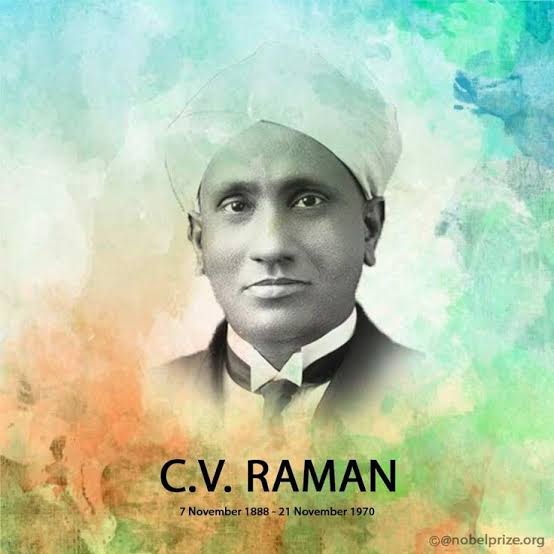
C. V. Raman
Indian Physicist and Nobel Laureate in Physics
🌍 Indian · Born November 7, 1888 · Died November 21, 1970
About
Sir Chandrasekhara Venkata Raman was a renowned Indian physicist whose landmark work in the field of light scattering revolutionized molecular physics and modern optics. Born in Tiruchirappalli, Tamil Nadu, Raman was a precocious student who completed his degree in physics at Presidency College, Madras, publishing his first scientific paper at the age of eighteen. Though he initially worked for the Indian Finance Department as an accountant, he passionately pursued scientific research in acoustics and optics in his spare time at the Indian Association for the Cultivation of Science in Calcutta. In 1917, he resigned from government service to become the Palit Professor of Physics at the University of Calcutta. On February 28, 1928, Raman, alongside his student K. S. Krishnan, discovered that when light passes through a transparent material, a small fraction of the scattered light changes wavelength—a phenomenon that came to be known as the Raman Effect. This breakthrough earned him the 1930 Nobel Prize in Physics, making him the first Asian and first non-white individual to receive a Nobel Prize in the sciences. Raman served as the first Indian Director of the Indian Institute of Science in Bangalore from 1933 to 1937 and established the Indian Academy of Sciences in 1934. In 1948, he founded the Raman Research Institute, where he actively pursued research on crystals, minerals, and visual perception until his death. In recognition of his immense contributions, he was awarded India's highest civilian honor, the Bharat Ratna, in 1954.
Intelligence Summary
Top Connections
Joined University of Calcutta
Appointed as the Palit Professor of Physics at the University of Calcutta, leaving civil service to pursue full-time academic research.
Discovered the Raman Effect
Discovered inelastic light scattering alongside K. S. Krishnan, leading to major developments in molecular spectroscopy.
Awarded Nobel Prize in Physics
Received the Nobel Prize in Physics for his work on the scattering of light and the discovery of the Raman Effect.
Appointed Director of IISc
Became the first Indian Director of the Indian Institute of Science in Bangalore.
Founded Indian Academy of Sciences
Established the Indian Academy of Sciences in Bangalore and served as its inaugural president.
Founded Raman Research Institute
Established the Raman Research Institute in Bangalore to serve as an independent center for advanced scientific research.
Conferred Bharat Ratna
Honored with the Bharat Ratna, India's highest civilian award, in its inaugural year.
No organizations found.
All data sourced from verified public references.
Prof. C. V. Raman
Indian Academy of Sciences
https://www.ias.ac.in/About_IASc/History/Prof._C._V._Raman →